


Back in April 2020, somewhere between the first lockdown and the complete collapse of normal life, Netflix dropped Outer Banks. The timing was almost too perfect. A group of sun-scorched teenagers hunting buried treasure on the North Carolina coast, running from corrupt sheriffs, falling in and out of love, and generally making the kind of chaotic, high-stakes decisions that only make sense when you're seventeen and convinced the world is yours to figure out. The world was very much not ours to figure out in April 2020. Outer Banks was a reasonable substitute.
Five seasons later, the Pogues are back for the last time. Season 5 landed on Netflix on 20 August, and this time there's no next chapter to look forward to. Whatever happens to John B, Sarah, Kiara, and Pope, this is it. They go into the finale already one Pogue short, with JJ's death at the end of season 4 still unresolved, unmourned, and hanging over everything the last season has to do.
As the finale lands, we pulled the numbers on what six years of Outer Banks actually looks like in audience data. The story behind the show is chaotic, romantic, and occasionally baffling.
1. A show that found its audience and kept it

Between April 2020 and June 2026, Outer Banks accumulated 2.7 billion title streams across 20 markets, reached 63.4 million accounts, and clocked 2 billion hours of viewing. The average account streamed it 43 times.US measurement begins in 2021, so these totals exclude the show's first year in market.
2. The UCAN stronghold, and the APAC surprise

Outer Banks reached 43.0% of active Netflix accounts in UCAN across the full run of the series. That is a substantial share for a show that, at its core, is a very American story about treasure maps, a sun-drenched North Carolina coastline, and a very specific strain of Southern-tinged teen drama.
But the more interesting number is APAC. Outer Banks reached 16.9% of active Netflix accounts across Asia Pacific. For context, Riverdale ran for seven seasons and reached 56.8 million accounts globally, yet managed only 9.8% in APAC. Outer Banks, an English-language series set on the American coast, reached over one and a half times that share, higher than its setting and language would suggest.
Whatever it is about the Pogues, whether it is the treasure hunt, the class conflict between Kooks and Pogues, or the ensemble chemistry, it crossed over in markets where the setting and cultural references had no particular home-field advantage.
3. Five years on, people were still discovering it for the first time
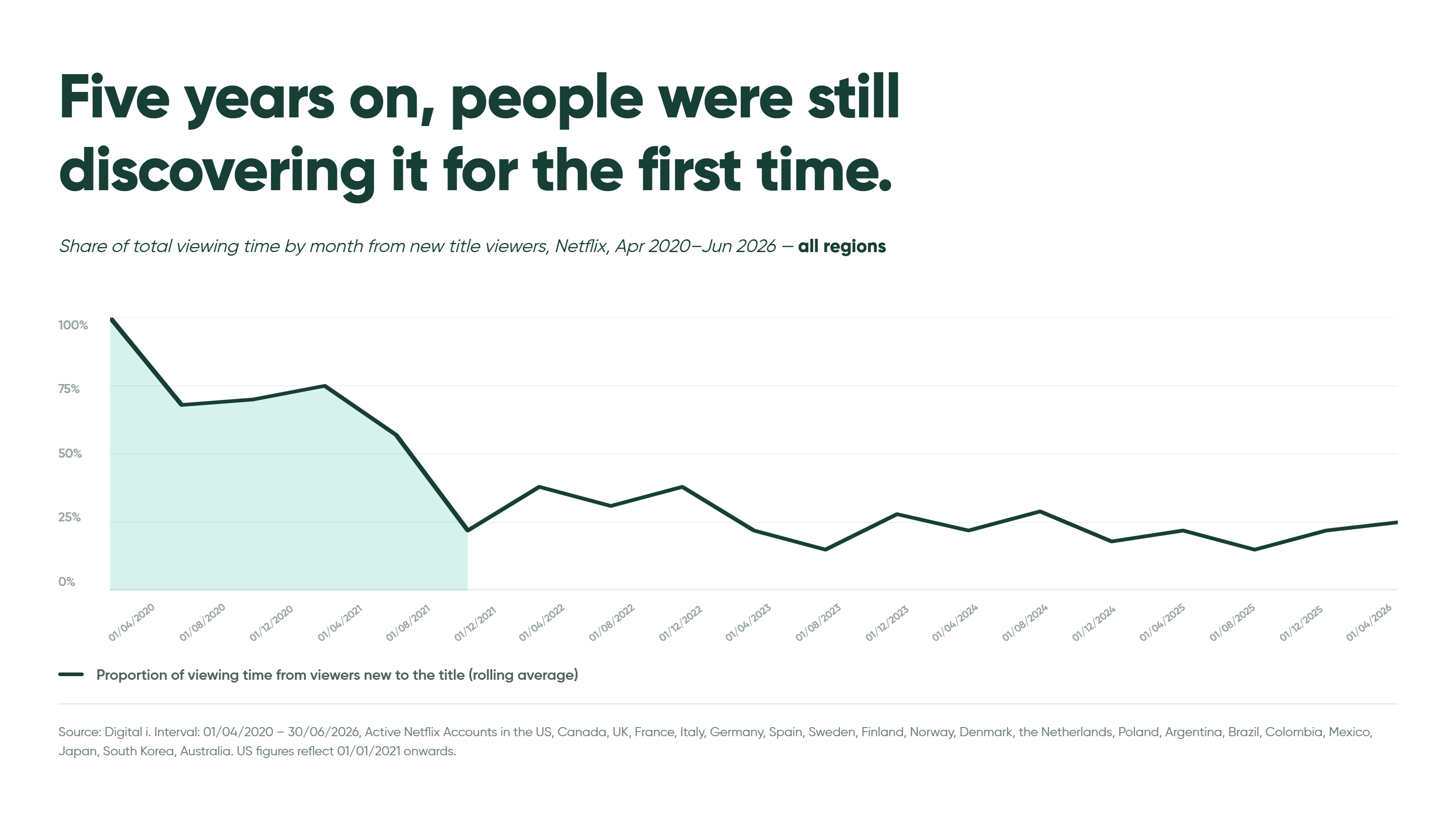
Outer Banks, despite running for over six years, continued to acquire new viewers to the show. In fact, in August 2025, 23% of viewing came from accounts who had never viewed the title before. Five years after launch. Nearly a quarter of all viewing in that month came from first-time audiences. That is a show that never stopped being discovered. Audiences did something similar on Disney+, returning to the original four Toy Story films before Toy Story 5 arrived.
4. The completion question and what it means for season 5
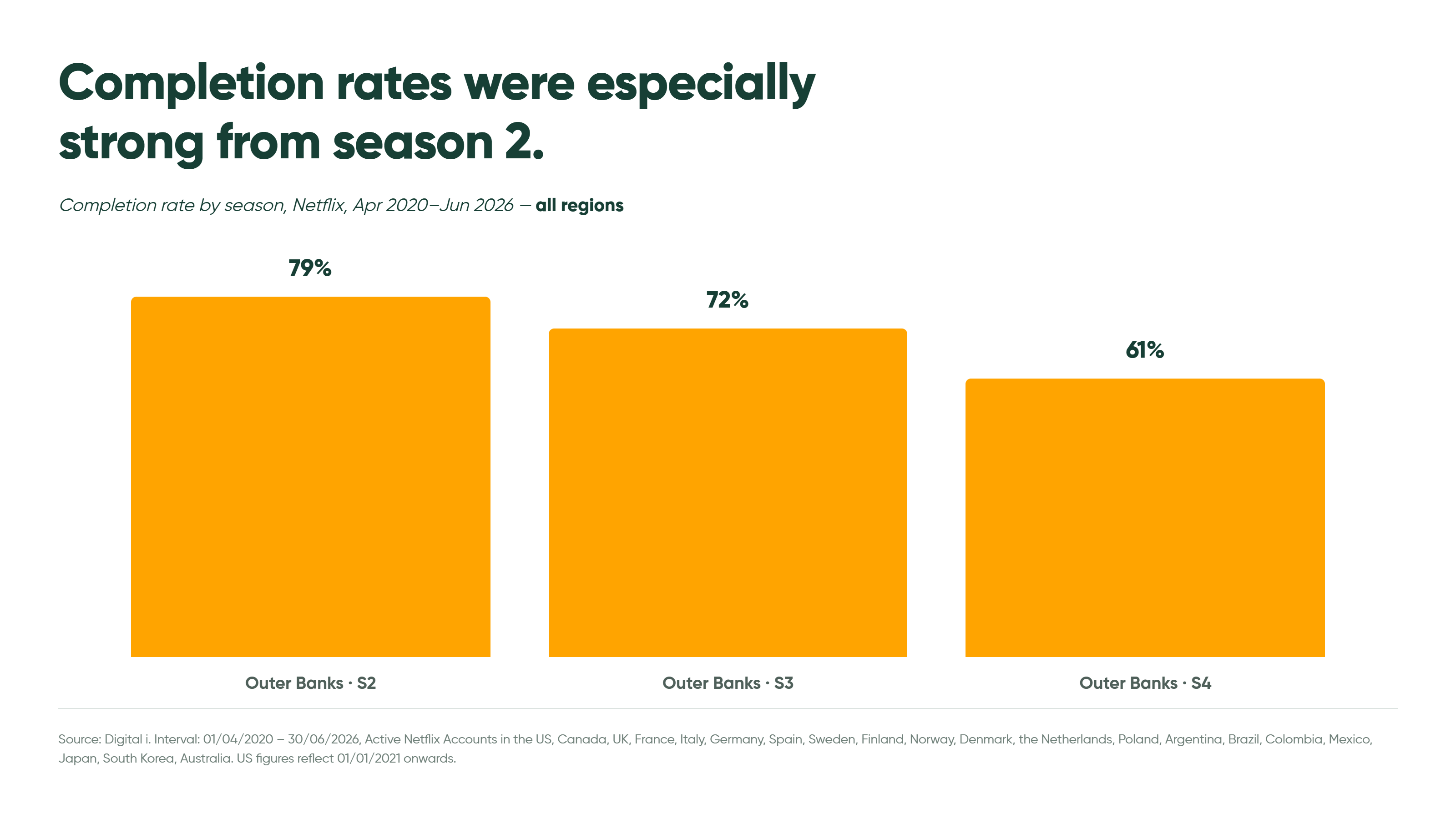
Completion rates across seasons 2, 3, and 4 tell a consistent story with an interesting trajectory. Season 2 completed at 79%. Season 3 at 72%. Season 4 at 61%. The decline is real, but the baseline is high. A 61% completion rate is not a show losing its audience. It is a show whose audience is still, overwhelmingly, showing up and finishing what they started. That level of retention is a strong result for any returning series.
Which raises the only question that matters heading into the finale: will audiences show up for season 5? The completion data says the fanbase is loyal. JJ's death at the end of season 4 says the show made a decision that changed its own internal logic. Whether those two things can coexist, a loyal fanbase and the permanent absence of one of its central relationships, is what the finale will answer.
5. The split release that ran the clock twice
Season 4 did something none of the previous seasons had done: it was released in two parts. Part A dropped first, Part B followed four weeks later. Seasons 1, 2, and 3 were full-season drops.
The audience data shows what that decision produced in practice. In the first 50 days after release, season 3 hit 10.2 million accounts on day zero and declined steadily from there. By day 28, it was down to 1.5 million. Season 4 Part A opened lower at 5.1 million and followed a similar decay curve through its first 28 days. Then Part B landed. Day 28 brought 4.8 million. By day 30 it had peaked at 6.0 million, a second surge that went above Part A's opening.
The show, in effect, had two opening weekends. Two moments where it re-entered the newly released section of Netflix, which could have carried it back into the top 10, and gave audiences who had missed Part A a reason to start from the beginning. Whether that was the intent or a happy side effect, the result was a show that stayed in meaningful conversation for three times as long as its season 3 equivalent.
Season 5 goes back to a full drop. Every episode, all at once. Netflix and the Outer Banks team have made a different bet this time, concentrated viewing, a single cultural moment, the finale treated as an event rather than a slow burn. Given the completion numbers and the loyalty the fanbase has shown across six years, that may be exactly the right call.
6. The end of the road for the Pogues
Five seasons. Six years. 2 billion hours of viewing, 63.4 million accounts reached, and a fanbase that was still discovering the show for the first time in 2025. Outer Banks earned every one of its renewals, and the numbers make that case without needing any help.
There is something fitting about the finale landing now, in the last weeks of August, as summer draws to a close. Outer Banks has always been a summer show at heart. Sun, salt, treasure, and the particular kind of drama that only makes sense when school is out and the stakes feel infinite. Saying goodbye to the Pogues as the season turns feels right in a way that is hard to fully explain but easy to feel.
The treasure hunt ends here. John B and Sarah's story reaches its conclusion. The Pogues face whatever the writers have decided is the final chapter of five seasons of chaos, gold, and Carolina coastline, and they do it with one member short.The numbers already told us this show had something. 2 billion hours don't lie. Now it just has to stick the landing.
.jpg)


