
Image by: Marjan Blan
Most shows peak in their first season and spend every year after trying not to lose what they built. The Boys spent five years doing the opposite. We tracked its full run on Prime Video from July 2019 to May 2026, premiere to its now-concluded fifth and final season, across 19 markets worldwide. While analysis for seasons 1-4 covers 19 global markets, the final season analysis is based on a refined footprint of the US, UK, France, Italy, Germany, Spain, and the Nordics. Here's what the data actually shows.
1. The Scale
2.1 billion streams. 47.2 million accounts reached. 1.9 billion hours watched. Every account that watched came back for 45 streams, on average. That high stream count reflects an audience that didn't just watch The Boys. They came back to it. With only 40 episodes across the full run, 45 average streams per account points clearly to rewatching behaviour.
Rather than casual viewing, these figures show sustained, repeated commitment to the dark, cynical universe Eric Kripke built. Viewers returned consistently to follow the fierce central rivalry between Karl Urban's Billy Butcher and Antony Starr's Homelander, through every twisted storyline, more than once.
2. 2nd Highest Reach Since 2019

One series on Prime Video has reached more viewers than The Boys since 2019. One. The Summer I Turned Pretty, at 38% reach. The Boys sits right behind it at 34%, ahead of Fallout, ahead of The Lord of the Rings: The Rings of Power, both at 29%. Five seasons. A consistent, committed audience throughout. Not a spike, not a slow burn, but a show that never lost its grip on the viewers it found from the start.
3. The Halo Effect

A launch-week headline can only tell you about the show that just launched. Five years of data can tell you something a headline never will: what happens to everything that came before it. Every time The Boys released a new season, its older seasons didn't fade into the background. They spiked. Season 3 landed in 2022, Seasons 1 and 2 jumped well above their normal baseline in that same quarter. Season 4 landed in 2024, Seasons 1, 2, and 3 all spiked with it. Season 5 landed in 2026, Seasons 1 through 4 spiked again.
Four new seasons. Four times, the old ones came roaring back. A new season didn't just draw an audience to itself. It sent viewers back to the beginning, every single time.
4. Not Just a Rewatch
It is easy to look at that pattern and assume it is just nostalgia, existing fans doing a quick rewatch before diving into the new episodes. But the data reveals something much more valuable happened.
Every single season launch actively pulled in a fresh wave of viewers who had never interacted with the show before. Take May 2022, the month Season 3 debuted: a massive 55.3% of all viewing time came entirely from first-time viewers, compared to just 24.5% the month before and 31.4% the month after. We saw the exact same trend in May 2024 for the Season 4 launch, which pulled a 40.4% new-viewer share, flanked by 16.7% and 11.3% in the surrounding months. Even by April 2026, when Season 5 premiered, it captured a 13.1% new-viewer share, a smaller number in absolute terms given how mature the show was, but still a distinct, sharp peak against the 6.2% before it and 6.5% after.
Right through its very last season, The Boys never stopped acting as an acquisition engine, constantly finding people who had never seen it before.
5. The Real Hook Is Episode 2
If one number explains everything else in this dataset, it's this: across five seasons and forty tracked episodes, the sharpest drop in the entire run happens in exactly one place. Season 1, Episode 1 to Episode 2. Reach falls from 100% to 74.3%, a 25.7-point collapse. Nothing else comes close. The next-biggest episode-to-episode drop, Episode 2 to Episode 3 of that same season, is 6.9 points. Not close to close.
Clear that first cliff, and the show stops losing viewers in drops. It loses them in inches, a few points a season, all the way through to Season 5, where the last tracked episode still holds 29.7% of the audience that watched the episode released back in 2019.
Here's the split worth sitting with. A chunk of the audience decides whether The Boys is for them inside one episode. Everyone who clears that bar does fall away gradually, season after season, but gradual is not gone, and the gap between those two things is most of this story.
6. Completeion Rate
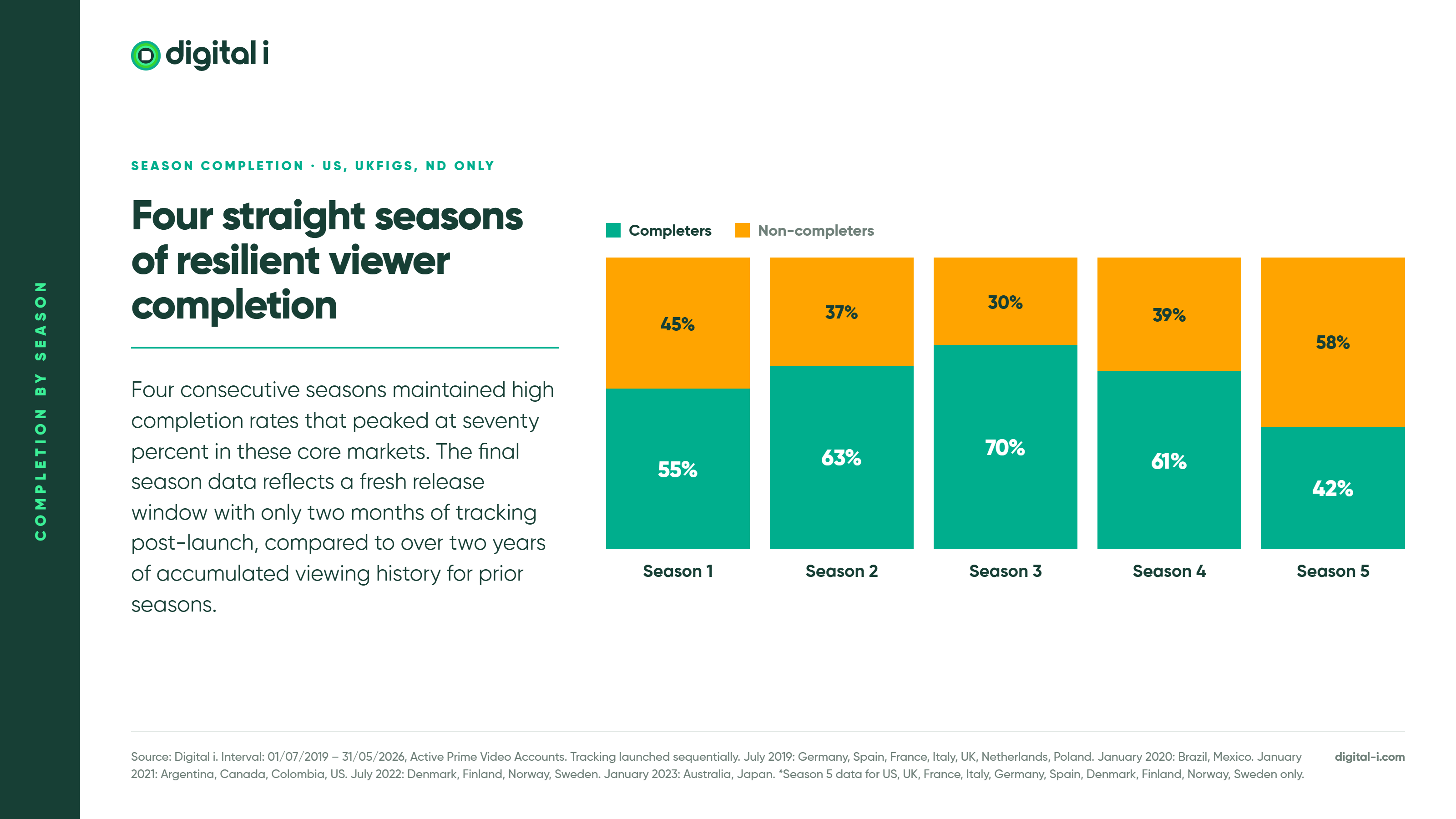
Season-level completion rate says the same thing from a different angle. Two cuts of the data, kept separate on purpose:
All regions: Season 1, 56%. Season 2, 66%. Season 3, 71%. Season 4, 60%. Season 5, 42%.
US/UK/France/Italy/Germany/Spain/ND only: Season 1, 55%. Season 2, 63%. Season 3, 70%. Season 4, 61%. Season 5, 42%.
Same range, both cuts. Four straight seasons between 55% and 71%. Season 5, the finale, and the newest season in the dataset, sits at 42% in both. That's not the number of a show losing its grip. That's not the number of a show losing its grip.
7. The Verdict
Seven years. Five seasons. One pattern, repeated every time: The Boys didn't coast.
It was the 2nd-highest-reaching series on the platform since 2019. Every new season pulled the old ones back into view. Every new season found people who'd never watched before. And once someone got past that first episode, most of them stayed for the ride. This wasn't a show holding onto an audience. It was a show that kept building one, right up to the end.
8. What's Next for the Universe
While The Boys has officially wrapped its final season, its universe is far from over. Two spin-offs are already out. How successful that universe truly is, beyond the original series, is a question this dataset alone cannot answer.
One final point worth stating plainly: this analysis evaluates Season 5 through the lens of the global data available today. We will return with a much deeper, dedicated case study soon, one built specifically to dissect the granular, long-term performance of the final season of one of Prime Video's most successful original series of all time.
Source: Digital i. Interval: 01/07/2019 – 31/05/2026, Active Prime Video Accounts. Tracking launched sequentially. July 2019: Germany, Spain, France, Italy, UK, Netherlands, Poland. January 2020: Brazil, Mexico. January 2021: Argentina, Canada, Colombia, US. July 2022: Denmark, Finland, Norway, Sweden. January 2023: Australia, Japan. *Season 5 data for US, UK, France, Italy, Germany, Spain, Denmark, Finland, Norway, Sweden only.