Data on total reach, viewing hours and streaming figures gets widely reported as a marker of success, but there is another metric that offers a key perspective on how users engage with SVOD platforms – their first view of the day.
Digital i defines this as the title first viewed on a streaming platform by a user after 4am local time.
In data first presented at the 2025 CIMM Summit, we delved into streaming on Netflix, Prime Video, HBO Max and Disney+, both in the U.S. and internationally, to shed light on what the first view of the day reveals about streaming consumption habits.
Pre-school priorities
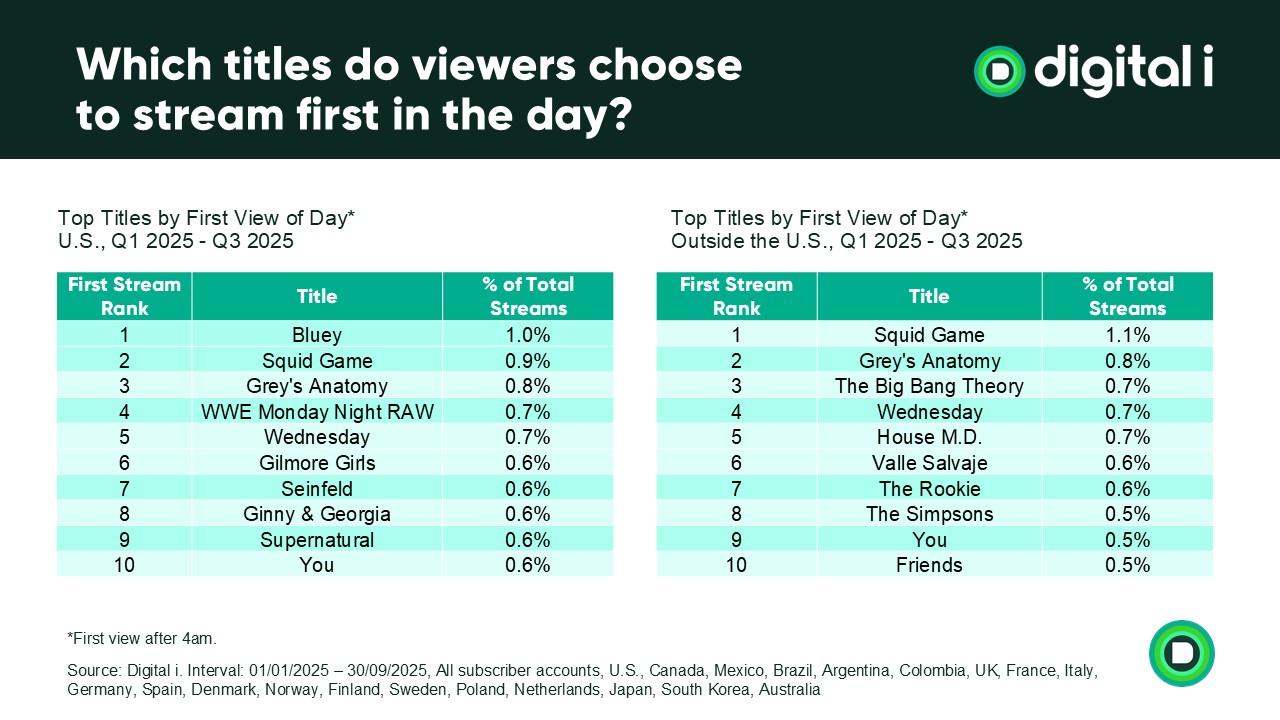
Australian animated series Bluey, on Disney+, topped the list in the U.S., accounting for 1% of all first streams across all four services during Q1-Q3 2025.
While that might seem like a small number, for a single show to own 1% of every single ‘first stream’ in the whole of the U.S. represents millions of views. For these American households, the first view of the day is a functional one – switching on a trusted, family-friendly programme, likely as part of a daily pre-school routine.
Netflix’s WWE Monday Night Raw, which appears in fourth place on the list, is live sport with a highly loyal audience for whom the show will be appointment viewing, making the title a similarly low-friction choice as a first view.
The rest of the U.S. top 10 was widely populated by what could be categorised as ‘comfort TV’. Titles like Grey’s Anatomy, Gilmore Girls, and Seinfeld suggest that for the American viewer, the first click isn't about discovery; it’s about familiarity.
These are ‘low stakes’ shows that viewers have likely seen before, helping them to avoid decision friction as they begin their leisure time.
International variation
Looking at the same data for countries outside the U.S. – in Canada, Mexico, Brazil, Argentina, Colombia, UK, France, Italy, Germany, Spain, Denmark, Norway, Finland, Sweden, Poland, The Netherlands, Japan, South Korea and Australia – presented a similar result with one key difference.
Squid Game took the number one spot at 1.1% of total first-view streams – and Bluey was nowhere to be seen - likely as a reflection of its wide availability on other services and broadcasters not measured here.
While Squid Game would be regarded as a ‘high investment’ viewing choice for audiences, the top 10 mirrored U.S. first views, encompassing ‘comfort’ sitcoms and procedurals such as Friends and The Rookie, alongside more intense, serialised dramas like Wednesday and House M.D and Spanish soap opera Valle Salvaje.
Common choices
Despite the regional differences, four titles - Squid Game, Grey’s Anatomy, Wednesday, and You - appear on both lists. These titles represent common ‘entry points’ into the streaming ecosystem that transcend national viewing habits and time zones.
The first view of the day is perhaps the most “honest” metric in streaming. It isn't influenced by autoplay features and is instead a conscious, intentional choice.
Our data suggests that viewers don't necessarily start their day - or evening TV time - with what is new or hyped, but often with what is familiar.
Activating audiences
The strategic importance of securing that first view is further underscored by the significant gap in daily reach between platforms.
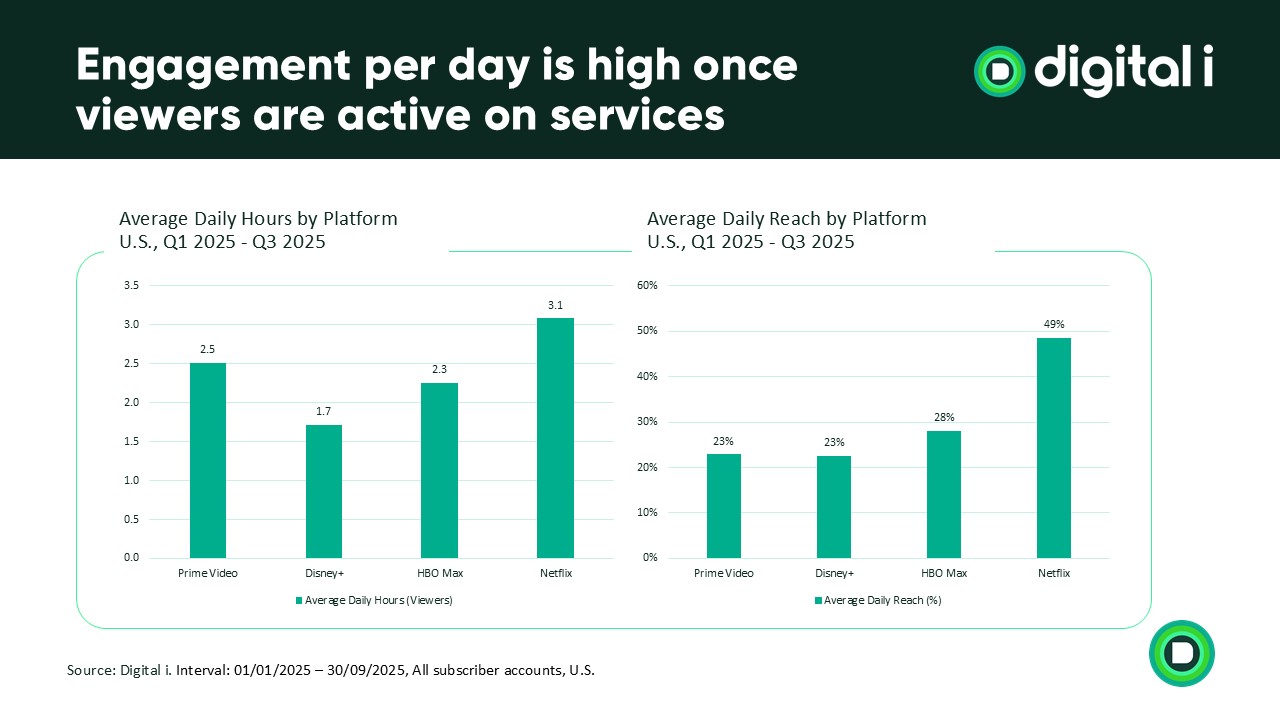
While Netflix consistently engaged nearly half (49%) of its subscriber base on any given day, other major services like Prime Video, Disney+, and HBO Max saw a much lower daily reach, with only about a quarter – between 23-28% - of their members tuning in.
However, our data suggests that the primary challenge for these platforms isn't necessarily the quality of the experience once the user is active; when these services do successfully draw viewers in, engagement is remarkably high.
Netflix again tops the chart with an average daily usage of 3.1 hours per user, but HBO Max and Prime Video viewers spend an average of 2.5 and 2.3 hours daily, respectively. Disney+ users averaged a lower but still significant 1.7 hours per day once users were active.
This suggests that the first view acts as a gatekeeper for these platforms. The specific content that can drive a user to open the app and make that first click is effectively gold dust - it is the catalyst that transforms a dormant subscriber into an active one.
.jpg)