.jpg)
At first glance, the biggest names on YouTube appear to dominate the landscape. Late-night giants, global streaming brands and major news networks reach tens of millions of users, suggesting that scale equals success.
But look a little closer at the data and a different story emerges. Reach on YouTube does not automatically translate into engagement – and in many cases, the most deeply watched content comes not from the biggest brands, but from niche creators with loyal audiences.
In research that I first presented at the Media Insights and Engagement Conference in Miami last month, Digital i data reveals a fundamental difference between how YouTube viewing differs from SVOD.
This is a platform driven by habit and high intent – where smaller audiences can generate outsized engagement and where choice, not just scale, shapes viewing behaviour.
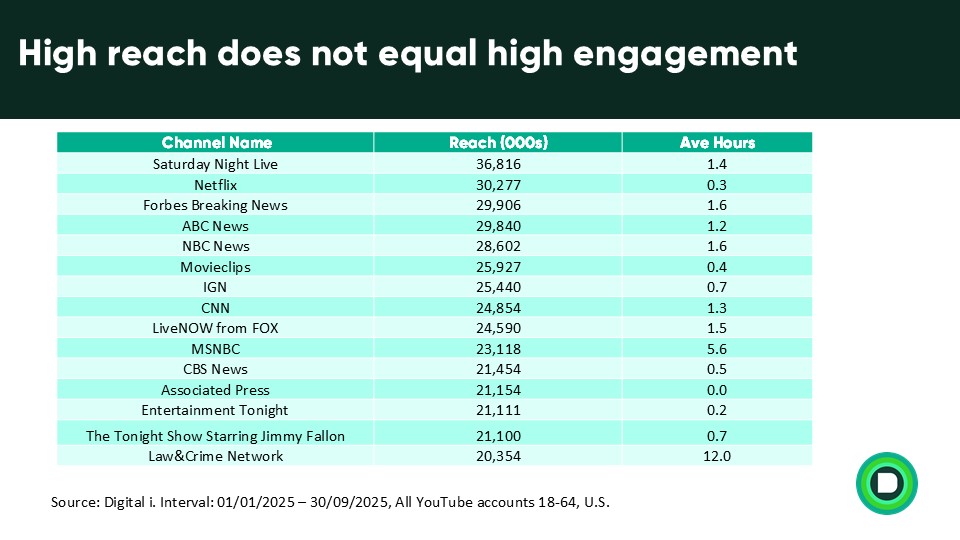
Measuring U.S. YouTube viewing between January and September 2025, the highest-reach channels – Saturday Night Live (36.8m), Netflix (30.3m), Forbes Break News (29.9m), ABC News (29.8m), NBC News (28.6m) – all deliver enormous scale.
Yet their average hours per viewer sit between 0.3 and 1.6. That is broad exposure, but relatively shallow time spent. These brands function as powerful discovery engines: audiences sample a clip, catch a segment or click on a headline, but the data suggests that their interaction, while frequent, is often brief.
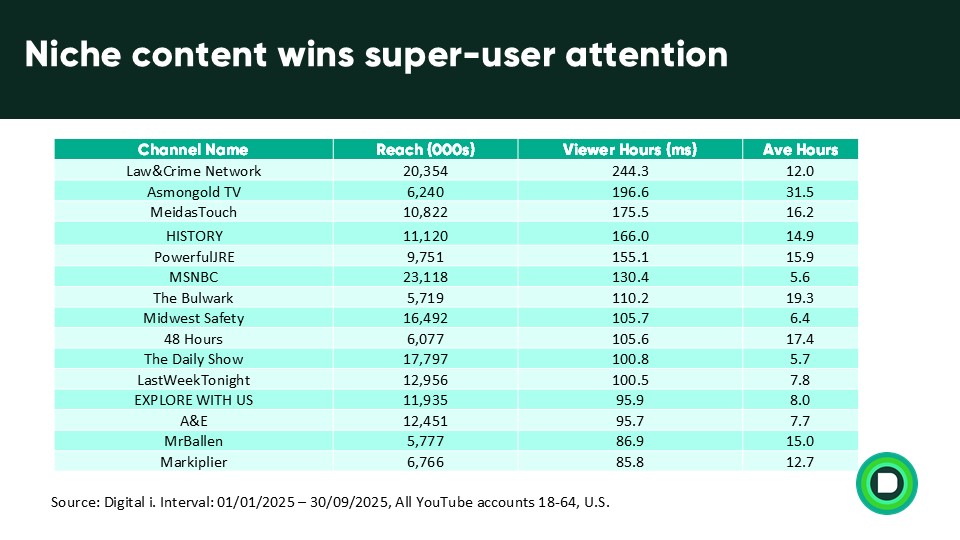
Meanwhile, more niche channels can capture viewers for longer and see them return through brand loyalty.
Channels such as Asmongold TV (6.2m reach, 31.5 average hours), The Bulwark (5.7m reach, 19.3 hours) and 48 Hours (6.1m reach, 17.4 hours) operate at a fraction of the reach of mainstream brands, yet command dramatically deeper engagement.
In pure attention terms, they punch far above their scale. A YouTube user watching 30+ hours of a single creator is exhibiting behaviour closer to fandom than casual consumption.
This is the structural difference between reach and engagement on YouTube. Reach measures how many people touched the content, while the measurement of average hours reveals how many choose to stay – and return. On a platform defined by algorithmic recommendations and personal subscription habits, repeated, intentional viewing compounds over time.
Our data shows that the biggest audiences are not always the most valuable ones, while the deepest audiences can be.
Put simply: on YouTube, reach does not equal engagement.